This website uses cookies to analyze site navigation and improve user experience.  We take your privacy seriously, and never collect any personally identifiable information, nor do we ever sell or share anonymized data with any third parties.  Click “Great!” to remove this banner.

2025 Solar Moonshot Program Wrapped

Programs

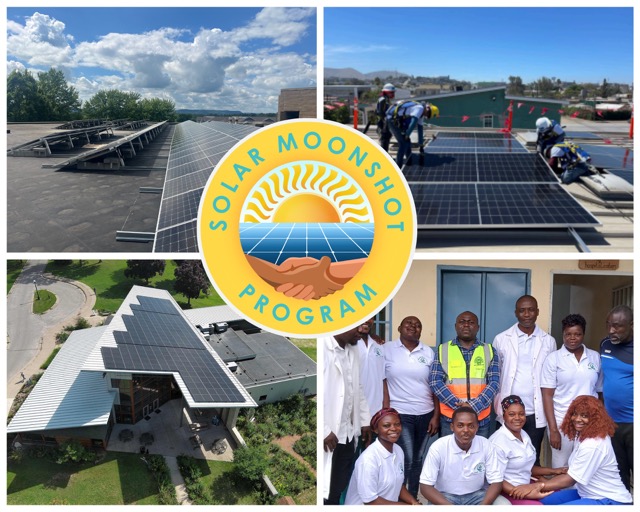
The Solar Moonshot Program helps schools, nonprofits, tribal organizations and community organizations overcome financial and technical barriers to solar adoption, delivering long-term savings and climate benefits where they matter most. 

‍

In 2025, the Solar Moonshot Program took a major step forward, expanding our reach, deepening our impact and providing real savings to nonprofits across the country and internationally. In 2024, the Solar Moonshot Program supported 26 projects and deployed $x. In 2025, the program supported 63 projects, representing a 142% increase year-over-year, and deployed $x. We also surpassed our 200th grantee and over $4,00,000 in solar grants issued since the program's inception in 2020. 

‍

2025 Solar Moonshot Program grantees were located in 16 states, reaching a wide range of communities across the United States, as well as three international projects in Mexico, the Philippines and Africa. Our grantees included school districts, libraries, tribal facilities, food pantries, medical facilities, homes for children and other nonprofit service providers providing vital services for Communities of Concern, organizations that often operate on tight margins but play an outsized role in community well being. Together, these investments unlocked around $600,000 in estimated savings directly to nonprofits, which translate into more predictable operating costs, protection from rising utility rates, and the ability to redirect resources toward mission-critical services like education, healthcare, cultural programming and community resilience. Each project contributes to reducing carbon emissions, supporting local clean energy jobs, progressing  local, state and national climate goals, helping organizations invest in staff and programs and provides an opportunity for the community to learn more about clean energy and lessening climate injustices. These clean energy projects are also reducing climate injustices, supporting regional grid stability and offering crucial back-up power during emergencies.  

‍

The drastic jump in the amount of projects we were able to support signals the demand for clean energy solutions, which will only increase as federal tax credits will begin to diminish in 2026. We remain committed to processing applications as quickly as possible to help our grantees maximize available funding to make their solar dreams possible. 

‍

"Our new solar system will help reduce operating costs for the Clinton Community Hall for decades into the future. We couldn’t have moved forward without the support of the Solar Moonshot Program. In addition to the generous financial support, their program is super accessible and the folks we worked with were so helpful throughout the process. Just such an amazing resource for smaller non-profit facilities like ours that might not otherwise be able to get solar installed.”

  • Clinton Community Hall, Washington 

‍

“Funding through the Solar Moonshot Program provided support for our solar array on our new building. With this boost in funding, we were able to invest more deeply in mission-related aspects of our new space, including managing stormwater on site and planting native species, as well as developing educational exhibits and displays that communicate the importance of our work to protect the Newfound Watershed.”

  • Newfound Lake Region Association, New Hampshire

‍

We are grateful to the program’s generous funders who make this impactful program possible, including our 2025 supporters: BQuest Foundation, San Diego Community Power in partnership with the San Diego Foundation and Calpine Energy, anonymous donors in California and Wisconsin and Palomar. 

‍

To learn more about the program or to apply for a 2026 grant, visit www.solarmoonshot.org. 

‍


‍

All Posts

Category
Select field
Thank you! Your submission has been received!
Oops! Something went wrong while submitting the form.

Celebrating a year of impactful climate action

The past year has been a testament to the undeniable urgency of addressing the climate crisis as extreme weather and flooding events, fires, drought, heatwaves and other climate emergencies are occurring worldwide.

The past year has been a testament to the undeniable urgency of addressing the climate crisis as extreme weather and flooding events, fires, drought, heatwaves and other climate emergencies are occurring worldwide. As California made decisions to side with the investor-owned utilities to make solar power less accessible and more expensive, the federal government made landmark investments in funding clean energy initiatives. Our team has been working tirelessly advocating for a just and livable future, which includes work behind the scenes working with Governor Newsom’s office, California Public Utility Commission staff and San Diego Community Power to provide feedback on and assist with advancing climate initiatives and programs.    

‍

As we grapple with the wins and losses this year brought, the Hammond Climate Solutions Foundation team is proud to have helped create a more just and livable future. We are grateful for our clients, nonprofit partners and climate champions that we have the pleasure of working with throughout 2023. 

‍

Climate Legislation 

‍

California was able to make some progress on climate through statewide legislation this year and our team was proud to offer our support on a handful of bills, some of which did not pass or did pass and were vetoed by Governor Newsom. By far the biggest win was Senate Bill 253, the Climate Corporation Data Accountability Act, which now requires companies making $1 billion or more to disclose their annual greenhouse gas emissions, forcing an estimated 5,400 companies in the state including Walmart, Exxon and Apple, to provide transparency and hopefully turn that transparency into true climate action. 

‍

Another climate win we were able to help support, along with our partner BQuest Foundation, was Senate Bill 355. The bill started as a bill to expand the eligibility requirements for the state’s Solar on Multifamily Affordable Housing Program,and after meeting with the bill author’s office, our team was proud to have language added into the bill to encourage a loan guarantee to increase utilization of program funds. Although the details still need to be worked out through the California Public Utilities Commission, the added language means that property owners could access the rebate on the front end. 

‍

As we celebrate these two huge wins in the legislature, we have also been actively campaigning to reverse language approved last year through Assembly Bill 205, a budget trailer bill that included a provision, which removed the current cap on utility taxes and mandates a utility tax on all ratepayers that has unlimited potential to grow. The bill was passed without any public discussion and would be the highest utility tax in the country in a state that already has the highest utility rates in the nation. Throughout this year, Hammond Climate Solutions Foundation and organization partners have submitted numerous letters to state legislators, Governor Newsom and the California Public Utilities Commission urging them to repeal the utility tax provision. We have also addressed this issue directly with legislators who have met with us in person. If this section of the bill is not repealed, then the changes will go into effect mid next year. 

‍

Rooftop Solar 

‍

Protecting and expanding rooftop solar has been one of Hammond Climate Solutions Foundation’s biggest policy priorities this year. Although the decision to cut rooftop solar benefits for homeowners in 2022 was a drastic decision and a huge step in the wrong direction, the investor-owned utilities and the California Public Utilities Commission took it a step further and began attacking solar for renters, farms and schools. In August the California Public Utilities Commission issued a proposed decision that would block renters, farms and schools from using their own solar energy. The proposal attempted to give the utilities full control over rooftop solar energy produced by any facility with multiple meters, meaning a school for example, would need to buy back their own solar energy from the utility at full price. Our team worked tirelessly to bring attention to this issue locally and statewide and submitted numerous comments. After delaying the vote on this decision numerous times, a revised proposed decision was released in November. The newly revised proposed decision allows tenants in multifamily buildings to use their solar energy in real time, but still blocks that right from property owners, schools and farms. This decision along with the cuts to rooftop solar benefits for homeowners made last year will make it harder for California to reach its clean energy goals, increase climate injustices, accelerate the climate crisis and ultimately shows how much power the investor owned utilities have.  

‍

Although both decisions are upsetting, we are proud of the advocates statewide who spent numerous hours ensuring their voices were heard and were proud to contribute to San Diego being listed as one of the top cities with the most public comments on this issue. 

‍

Local Climate Action 

‍

While Hammond Climate Solutions Foundation has remained very engaged on statewide issues, our team has also stayed involved with local climate initiatives. Over the course of the year, we submitted numerous letters to the City of San Diego City Council and Mayor Todd Gloria on issues ranging from funding for the Climate Action Plan, building electrification, recommendations for budget prioritization and more. 

‍

We also remain engaged with the County of San Diego as they develop their Regional Decarbonization Framework, providing feedback as they release information.  

‍

We are proud to hold trusted relationships with local elected officials and be looked at as subject matter experts on issues like net energy metering and rooftop solar. This year, we were invited to participate in two elected officials’ environmental roundtables where we proposed ideas for future bills and policies and discussed our team’s priorities. 

‍

We were also proud to help the Let’s Go! San Diego Coalition raise awareness on a proposed transit improvement measure, which has successfully passed the 10,0000 signature requirement to go on the 2024 ballot. 

‍

Looking Forward to 2024

‍

Our team is involved in numerous coalitions, serving in leadership roles and intend to continue our involvement with the San Diego Green New Deal Alliance, California Alliance for Community Energy, San Diego Community Power, San Diego Building Electrification Coalition and Grid Alternatives San Diego. In addition to continuing our climate advocacy and policy efforts, we are also working hard on our climate programs like the Solar Moonshot Program and our e-bike programs. 

‍

Please connect with us on social media: Facebook, LinkedIn, Instagram and X (formerly Twitter, and to ensure you receive updates in the future, sign up for our newsletter.

‍

We look forward to working with all of you in 2024 to create a more resilient, equitable and healthier future for all. 

‍

Read more
Villa Lakeshore Apartments in Lakeside, which BQuest provided a SOMAH bride loan for, allowing the property to install solar, which saves tenants $1,600 a year on utility bills

California bill could restructure traditional incentive programs

New bill could restructure traditional incentive programs in California

It is no secret that traditionally, clean energy infrastructure has primarily been accessible to wealthy homeowners in California. More than a million homes and businesses have rooftop solar, but the state’s environmental justice communities, which are in the most polluted areas, have been left out. In order to reach the state’s climate and clean energy goals, it is necessary to provide clean energy access to everyone and a big part of how we get there is programs. 

‍

The Solar on Multifamily Affordable Housing (SOMAH) Program was created by California Assembly Bill (AB) 693 introduced by then Assemblymember Susan Eggman in 2016, which included the largest investment of its kind in the nation - $1 billion over the next decade from five of the state's gas and electric  investor-owned utility companies greenhouse gas cap-and-trade auction proceeds to subsidize solar panels on multifamily affordable housing across the state. For tenants, this means reduced utility bills, better housing security and job training opportunities. For housing complex owners, the solar reduces common area electricity costs, reducing overhead expenses. The program had a very successful launch, becoming fully subscribed within the first 24 hours of opening the program with more than 240 applications representing 74MW of solar capacity. However, after the successful launch, the program has experienced a significant decrease in applications in subsequent years, only receiving a total of 20 applications in 2022. 

‍

A required third-party evaluation of the program identified a number of barriers to program participation. A major barrier cited from property owners was gap financing. SOMAH Program projects can be lengthy, and the current incentive structure requires the property owner to float the rebate amount, which can be thousands of dollars to hundreds of thousands of dollars, sometimes for a year. The program recognized this issue and rolled at progress payments, which paid a portion of the incentive for certain project milestones, but this simply is not enough for some property owners. Recognizing the need for gap financing in order for these projects to participate in the program, Hammond Climate Solutions Foundation and BQuest Foundation began working together to provide no interest bridge loans for SOMAH projects, providing much needed funds for projects that would have otherwise not moved forward. After funding a handful of projects, BQuest realized they could scale this opportunity a lot more quickly and reach many more property owners by creating a loan guarantee instead of financing these projects on a one by one basis. A loan guarantee would allow the property owner to access the rebate on the front end, backed by a loan guarantee from BQuest, without putting ratepayer money at risk and allowing BQuest to scale their impact. 

‍

In February 2023, Senator Eggman introduced Senate Bill (SB) 355, which expanded SOMAH Program eligibility to include tribal housing, housing owned by public agencies and increased the income threshold among other things. At this point, Hammond Climate Solutions Foundation and BQuest had already been involved in numerous meetings with the SOMAH Program administrators, the California Public Utilities Commission (CPUC) energy division staff, the Governor’s Office and were actively involved in the SOMAH proceeding at the CPUC and while support for this idea was given by all parties, implementing something like this had proven to be slightly more difficult. Since SB 355 addressed the lack of applications in the SOMAH program and expanded eligibility, we met with Senator Eggman’s staff and proposed an amendment to the bill to include language for a loan guarantee and not only was the language added with no opposition, it was signed by Governor Newsom on October 7! 

‍

This is a huge win for California and an opportunity to prove that incentive programs structured in a way that provides the rebate on the front end can work and will eliminate barriers to participation. You can read the full bill text here.     

‍

Read more
Photo of the largest rooftop community solar project in the U.S, located in Carroll County, Maryland

California could lead the nation in Community Solar, if the utilities stop fighting it

California leads the nation in rooftop solar installations but has fallen short in creating a viable community solar market. Now, that can change.

California leads the nation in rooftop solar installations but has fallen short in creating a viable community solar market. Last year, Assembly Bill 2316 (AB 2316) unlocked the potential for California to lead the nation in community solar over the coming years by finally creating legislation that will tell the utilities to create a program that will credit customer’s accounts for renewable electricity produced elsewhere and set a compensation for the bill credit. Now, the utilities are attempting to derail a new proposed program called the Net Value Billing Tariff (NVBT).  

‍

The NVBT would finally allow California renters, nearly 17 million people, and low-income households to take advantage of bill savings while using clean energy. There are a couple of things that make the NVBT different from failed community solar programs in California. The first is that it would require the installation of batteries with community solar projects, to alleviate the strain on the grid during peak hours (currently 4-9 p.m.), once demand is higher and solar energy being exported to the grid is dropping off as the sun sets. The second is that AB 2316 requires that low-and-moderate income households make up a majority of subscribers, ensuring that this program will benefit those who are paying a disproportionate amount of income towards skyrocketing electricity rates. Finally, this program has no caps on capacity, meaning the doors are truly open for developers that want to build these projects. 

‍

One of the biggest advantages of community solar is that the solar power systems can be placed on rooftops and in parking lots, and the systems don’t require large plots of land like utility scale solar does. Community solar can also support local clean jobs and stimulate the regional economy. With the state’s target to procure 85 gigawatts of clean energy by 2035, there is already a large amount of projects in the desert trying to connect to the grid, however community solar projects can be a lot closer to the customers they serve, meaning they are able to connect to the lower voltage grid, eliminating the need for more costly and fire-causing transmission and distribution lines.    

‍

It is no surprise that the only arguments against a program that could potentially replace dangerous peaker plants comes from the state’s three investor-owned utilities. The main argument coming from the utilities is that community solar should be treated like large-scale generators that have a different set of rules and guidelines than other distributed energy resources like rooftop solar. 

‍

The California Public Utilities Commission proceedings tend to move pretty slowly, so there isn’t a definitive date for when we can expect the NVBT to be voted on by the commissioners. California has now passed the September 26 deadline for states to apply to $7 billion in federal funding as part of the Solar For All grants and having a community solar program in place would have made California’s application a lot more competitive.

‍

While the utilities have successfully blocked attempts to make solar more accessible, including the decision to slash the state’s net energy metering program last year, hopefully the state can get it right on this one.

‍

Read more